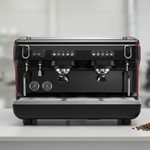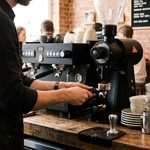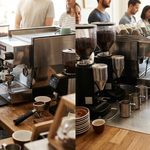

It is 8:05 on a Monday morning, and eight people are queuing. With one group head, shot number nine cannot start until shot number eight is finished. With two, you are pulling two shots at once. That small difference is the heart of the one group vs two group espresso machine decision.
In this guide, we skip the jargon and give you a simple way to decide. You will find a quick answer and a peak-hour sum you can do on a napkin. There is also a scorecard for the grey zone in between. By the end, you will know which machine your café needs.
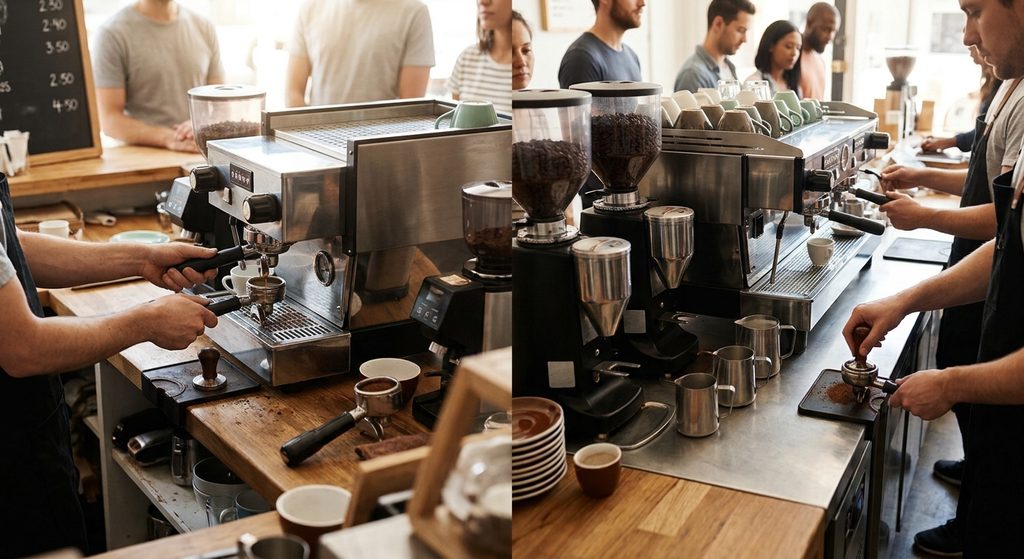
The 20-Second Answer: One Group vs Two Group at a Glance
- Choose one group if your busiest hour is under about 30 drinks and one barista runs the coffee. Space should be tight too.
- Choose two groups if your busiest hour is roughly 30 to 80 drinks. The same goes if coffee is a main source of income.
- Stuck in between? Read on, because the grey zone has its own rules.
Do the Peak-Hour Sum First
In the one group vs two group choice, your busiest hour matters more than your daily total. For example, a café can serve 200 drinks a day on one group if they are spread evenly. However, if 100 of them land between 7 and 8 a.m., the queue grows fast.
So do this simple sum. Multiply your daily drinks by the share that lands in your busiest hour. A café selling 250 drinks a day, with a fifth of them in the morning rush, serves about 50 drinks in that hour. Likewise, a café selling 300 drinks, with a quarter in the rush, faces 75. That is firmly two group coffee machine territory.
Then add 25 to 50 percent for growth, and be realistic, not optimistic.
One Group vs Two Group Espresso Machine: Side by Side
This table shows rough figures from a US equipment supplier, so treat it as a guide, not a rule.
| One group | Two group | |
|---|---|---|
| Best for | Tiny cafés, kiosks, bakeries | Neighbourhood cafés, restaurants |
| Drinks per day | Fewer than 80 | 80 to 300 |
| Busiest hour | Fewer than 30 drinks | 30 to 80 drinks |
| Baristas at once | One | One or two |
| Output per hour | Roughly 25 to 35 drinks | Roughly 60 to 120 drinks |
| Counter width | Around 45 to 60 cm | Around 70 to 80 cm |
| If a group fails | Espresso stops | The other group keeps working |
| Room to grow | Limited | Often covers 50 to 100 percent more |
Why Two Groups Feel Like Insurance
A one group machine has no backup. If its only group head has a problem, your whole espresso menu stops until it is fixed. With a two group coffee machine, you can keep serving on one group while the other waits for repair.
There is a second advantage. Most commercial machines are built as two group units, so you get the widest choice of models and spare parts. As a result, many suppliers call two groups the sweet spot for new cafés. Brands in our range, such as La Cimbali and Nuova Simonelli, often come in several group sizes.
Automatic machines that dose the water for you can add speed and consistency. So a well-chosen one group may do more than you expect. Our guide to automatic vs manual coffee machines explains the difference.
The Grey Zone: When Your Busiest Hour Is 30 to 50 Drinks
Here is something guides rarely admit. They draw the line in different places. One supplier suggests one group for busiest hours under about 30 drinks. A café planning workbook, meanwhile, treats about 50 drinks an hour as one group’s job.
So between 30 and 50, the answer depends on you. Give yourself a tick for each statement that is true.
- Coffee is a main source of income for the café.
- Two people may work the bar at the same time.
- You expect to grow within two years.
- A day without espresso would hurt badly.
- You have room for a machine about 70 cm wide.
Three or more ticks? Then two groups win the one group vs two group contest. Fewer than three? One group is enough for now.
Small Café Equipment: What Else Sets Your Capacity
Whichever you choose, group heads are not the only limit on café machine capacity. Four other things matter just as much.
- The grinder. It must keep pace with the machine, or the queue forms there instead.
- Steam power. Milk drinks need enough steam, so match the boiler to your group heads.
- Barista skill. A trained barista on two groups can outproduce a beginner on three.
- Workflow. Plan two portafilters and several milk jugs for each group head, so something clean is always ready.
For a full kit list, see our guide to coffee accessories in Sri Lanka.
One Group or Two Group: Four Traps to Avoid
- Buying for looks. A grand machine impresses visitors, but it ties up money that a better grinder or training could use.
- Ignoring the rush. Averages hide your busiest hour, which is the number that decides.
- Forgetting space. More groups need more room to work, so a cramped bar slows everyone down.
- Underbuying to save money. Upgrading later means downtime, and a used machine often sells at a loss.
A Sri Lankan Café Check for One Group or Two Group Machines
A few local questions come before any order.
- Power. Larger machines often need a stronger electrical supply, so ask your supplier and an electrician early.
- Water. Hard water scales boilers, so plan a filter or softener.
- Support. Ask who installs, services and supplies parts, and whether staff training is included.
Our guide to choosing commercial coffee machines covers these in more depth. Meanwhile, our coffee machine price guide helps you set a budget.
Ready to settle the one group vs two group question? Browse our coffee machines, or talk to the Colombo Coffee Company team, and we will help you match a machine to your busiest hour, your staff and your space.