
Picture a regular who orders a flat white every morning. On Monday, it is perfect. On Thursday, it tastes sharp and sour. She will not blame your grinder. She will blame your café. That is why a commercial coffee grinder in Sri Lanka is not a side purchase. It is the quiet salesperson that decides whether customers come back.
In this guide, we skip the jargon and give you five simple tools. First comes a grams-per-hour sum, and then a burr-size guide. After that, you get a five-minute demo test, a burr budget and a dial-in diary. By the end, you will know exactly what to look for.
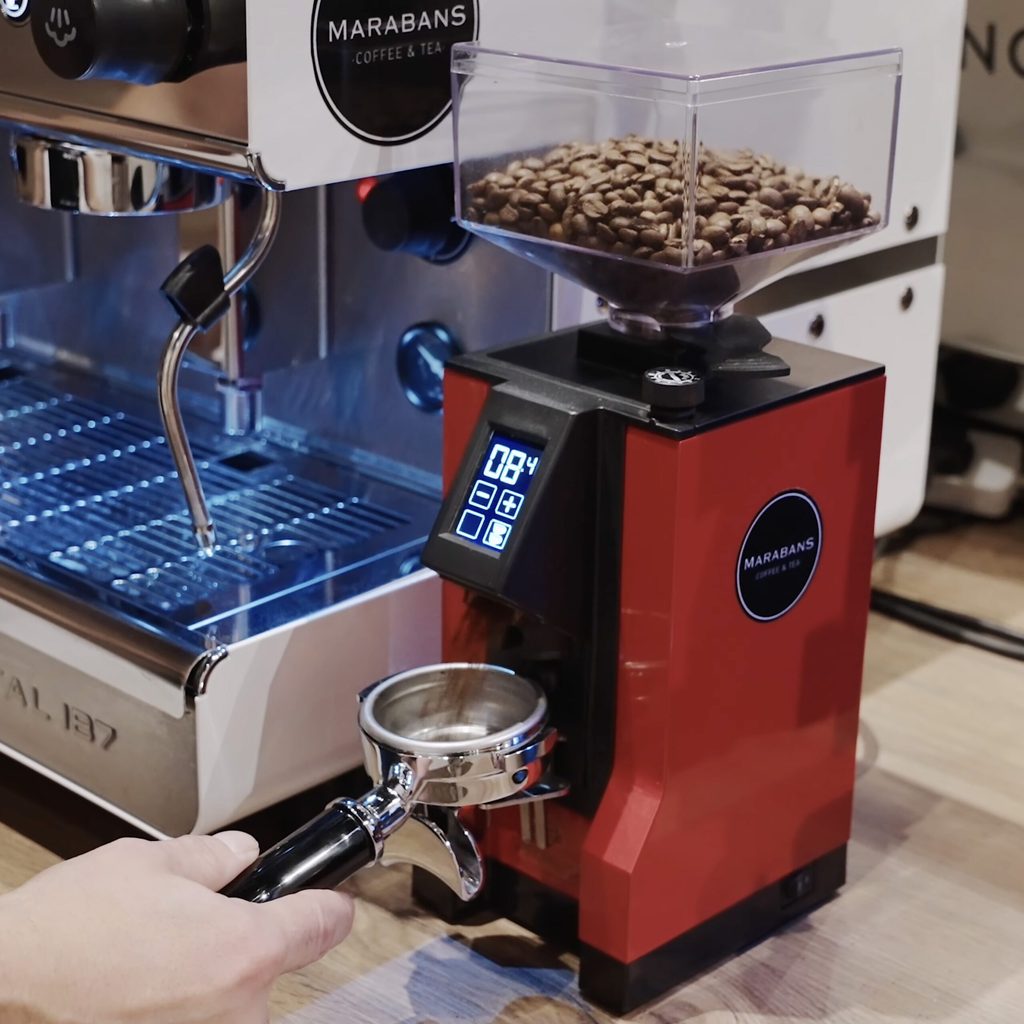
Your Commercial Coffee Grinder Is the Quiet Salesperson
A machine gets the praise, but the grinder sets the baseline. If the grounds are uneven, no machine can fix the cup. Even worse, an under-sized grinder becomes the bottleneck on your busiest, most profitable hour, as this buying guide warns.
Many experienced operators therefore spend more on the grinder than first-time owners expect. Customers cannot name a grind setting, but they notice when a cup tastes different. So consistency is the real product you are buying. Treat your commercial coffee grinder as part of the bar’s engine, not as an accessory.
Coffee Grinder Capacity: Do the Grams-per-Hour Sum
Capacity sounds technical, but the sum is simple. Take your busiest-hour drinks, multiply by the grams in each drink, and divide by 1,000. For example, 60 drinks at 18 g each is about 1.1 kg of coffee in that hour. Then add 30 percent for growth, which gives roughly 1.4 kg.
Over a whole day, the numbers stay modest. A café serving 300 drinks a day grinds about 5 kg, according to this café grinder guide. So capacity in a commercial coffee grinder is really about three things: how fast a dose drops, how long the grinder stays cool, and how much the hopper holds. Our guide to one group vs two group espresso machines helps you find your busiest-hour number before you choose a commercial grinder.
Burr Size and Shape: What to Know
Burrs are the two toothed rings that crush the beans. Larger burrs grind faster at a lower speed, so a commercial coffee grinder with big burrs stays cooler and calmer in a rush. Guides draw the lines in slightly different places, so treat these as ranges.
- Small cafés: 64 to 75 mm burrs, for up to about 150 drinks a day.
- Medium cafés: 75 to 83 mm burrs, for roughly 150 to 400 drinks a day.
- Busy cafés: 83 mm or larger, for more than 400 drinks a day.
One supplier suggests that a mid-size 64 to 65 mm grinder tops out around 200 drinks a day, as this commercial grinder guide explains. As for shape, flat burrs give very even particles and a clean, sweet cup. Conical burrs, by contrast, spin slower and run cooler. Most café coffee grinder models for espresso use flat burrs, and stepless adjustment gives you finer control.
On-Demand, Doser or Single Dose?
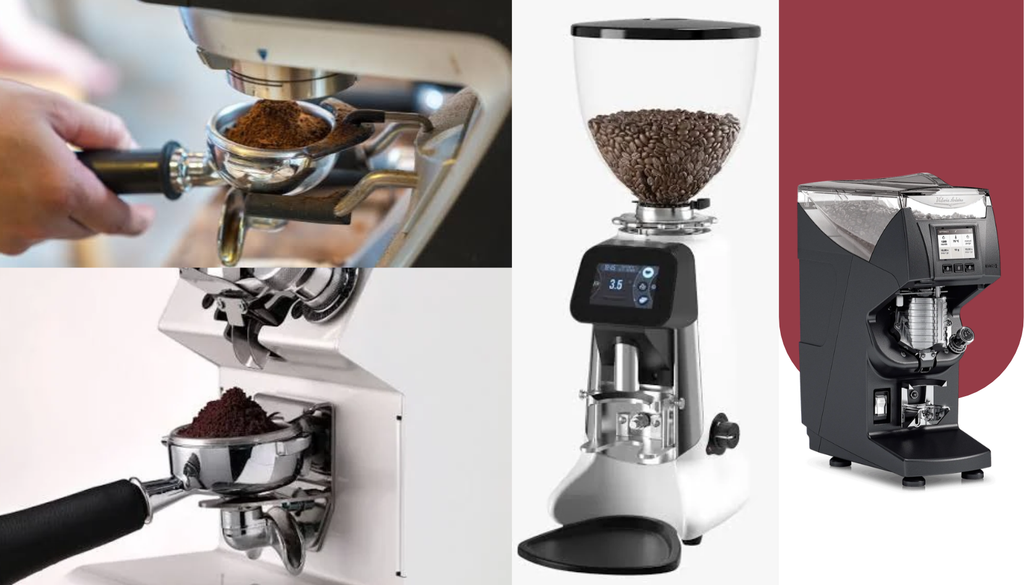
A commercial grinder comes in three main styles.
- On-demand: it grinds straight into the portafilter, so every shot uses fresh coffee, and it suits most cafés.
- Doser: it stores ground coffee in a chamber, so grounds can go stale before they are used.
- Single dose: you weigh each dose by hand, which suits specialty bars but slows a busy service.
Grind-by-weight models add accuracy, since they measure each dose for you. For a compact bar, that precision can be worth the extra cost. Our guide to the La Cimbali M23 UP and Elective grinder shows one on-demand espresso grinder that grinds and tamps on its own.
Pick Your Café Coffee Grinder Personality
Which café coffee grinder sounds like your bar?
- Rush Hero: you serve more than about 150 drinks a day, so choose larger burrs, on-demand grinding and low retention.
- Steady Neighbour: you serve a steady flow, so a 64 to 75 mm on-demand grinder with programmable doses fits well.
- Craft Keeper: you rotate beans often, so look for stepless adjustment and grind-by-weight.
- Pocket Café: you run a kiosk or cart, so a compact 58 to 64 mm on-demand grinder keeps the counter clear.
The Five-Minute Demo Test for Any Espresso Grinder
Specifications only tell half the story. So bring your own beans and a scale, and ask to test the espresso grinder.
- First, time ten doses.
- Next, weigh each dose, and note how much they vary.
- Then listen at bar height, because noise adds up over a long shift.
- After that, change the setting and purge. Less old coffee should come out, because low retention means fresher grounds.
- Finally, adjust the grind and see whether the dial moves smoothly and holds its place.
Write the results down, and compare two or three grinders side by side, so the decision rests on facts, not on a sales pitch. If a supplier will not let you test, ask why.
The Burr Budget and Your Dial-In Diary
Burrs in any commercial grinder wear, just like tyres, so plan for it. A café using 5 kg a day grinds about 150 kg a month. Divide the burr’s rated life by that number, and you know when to plan a change. Some coated burrs are rated for thousands of kilograms, as this 2026 buying guide notes, so always ask for the rated life.
Also keep a dial-in diary. It needs only five columns: date, dose, yield, time and taste note. As a result, your team can repeat a great shot and spot drift early. Our guide to coffee accessories in Sri Lanka lists the scale and tools that make this easy.
A Sri Lankan Check for Your Commercial Coffee Grinder
A few local questions come before any order.
- Humidity: keep the hopper lid on, and avoid overfilling, because damp air dulls beans and clogs chutes.
- Heat: place the grinder away from steam and ovens, since a hot grinder drifts.
- Power: check the plug and the voltage rating of your commercial grinder, because Sri Lanka runs on 230 V.
- Support: ask who supplies spare burrs and services the grinder locally.
- Cleaning: keep a small brush and a dry cloth beside the grinder, because coffee dust and ants find each other quickly.
Do you need a second grinder? If you serve decaf or a guest coffee, a second small grinder saves you from re-dialling all day. Meanwhile, our guide to choosing commercial coffee machines covers the machine side, and our barista training helps your team use both well.
Ready to choose your grinder? Browse grinders in our shop, or talk to the Colombo Coffee Company team. We will help you match a commercial coffee grinder to your machine, your busiest hour and your beans.